Thứ Năm, 16 tháng 2, 2017

What could cause Donald Trump to lose his base?


FILE — In this Oct. 21, 2016, file photo Republican presidential candidate Donald Trump arrives to speak at a campaign rally, in Johnstown, Pa. (AP Photo/Evan Vucci, File)

Zachary Karabell has an excellent column in Politico pointing out an awkward fact: For all the hullabaloo, the Trump administration hasn’t actually done all that much three weeks into the administration:


There is a wide gap, a chasm even, between what the administration has said and what it has done. There have been 45 executive orders or presidential memorandums signed, which may seem like a lot but lags President Barack Obama’s pace. More crucially, with the notable exception of the travel ban, almost none of these orders have mandated much action or clear change of current regulations. So far, Trump has behaved exactly like he has throughout his previous career: He has generated intense attention and sold himself as a man of action while doing little other than promote an image of himself as someone who gets things done.

It is the illusion of a presidency, not the real thing.

If you look beyond the executive orders, Karabell’s thesis still holds up. So far, Trump’s greatest accomplishments have been to nominate a competent Supreme Court justice and get most of his occasionally competent cabinet confirmed by the Senate. That’s it. On the debit side of the ledger, Trump has already lost his national security adviser, which I believe is a new land-speed record for the departure of a foreign policy principal.

There’s a paragraph in Greg Miller and Philip Rucker’s Washington Post story on Michael Flynn’s resignation that’s quite breathtaking:


The White House faces an escalating court fight over an immigration ban aimed at Muslim-majority countries, has alienated key allies with Trump’s brusque phone calls to foreign leaders, and seemed so caught off-guard by North Korea’s recent ballistic missile test that Trump and senior officials were shown learning of the development on cellphones in full view of patrons at Trump’s Mar-a Lago resort.

So let’s be super-generous and say that the first few weeks of Trump’s administration have been a mixed bag.

We know from public opinion polling that this isn’t exactly playing well with the American people. But we also know that the Trump administration doesn’t care about all the American people, not really. Last week there was an interesting tidbit tucked into a Politico story on Trump’s relationship with Capitol Hill:


Conway, multiple sources said, shrugged off the concerns from thousands of people jamming phone lines critical of Trump’s Cabinet nominees, explaining that she’s more worried about her own “RPI” or “Real Person Impact” meter.

“She basically said the people jamming up the phones don’t matter to this White House,” the communications director [for a Republican senator] continued. “That this administration just cares about what matters to ‘real people.’”

That’s the repellent part of Populism 101, but for now let’s focus on Trump’s base. Politico’s Adam Wren served up interesting piece of reporting on how the first few shambolic weeks of Trump’s administration are playing in a bellwether Indiana county. What he found will be somewhat disheartening to Trump critics:


To a person, the Trump voters I talked to in Vigo offered a similar refrain as they assessed Trump’s first days in office, almost as if they were reading from a fresh batch of talking points issued by the president’s director of Surrogate Outreach: “He’s doing exactly what he promised he would do,” Kelly, 48, a pharmacist in Terre Haute who felt uncomfortable divulging her last name, told me when I asked her about Trump’s controversial immigration executive order, as she ate a slice of cheese pizza at the food court in Honey Creek Mall. Nor are voters like Kelly lamenting his Twitter tirades: “He’s speaking directly to the people. Like Reagan!” Dick told me over lunch. Trump’s brusque, shoot-from-the-hip conversations with world leaders and allies? “We’re not going to go to war with Australia,” Kindsvatter said.

“I think he’s pretty much following The Art of the Deal,” said Ken Warner, 60, who works in the finance industry. “He’s got the price of fighter jets down. It’s not something we’re used to. It’s a little unorthodox. Listening to his Carrier negotiation, you have to shrug on the means but can’t disagree with the ends. You don’t want to be picking winners and losers. You don’t want to see a president calling out people on Twitter. However, the results so far have not been bad. So I can’t say it’s wrong.”

This is the flip side of Karabell’s column. It is true that Trump hasn’t actually done all that much. But that also means that the new president, for all of the national security foul-ups, also hasn’t done anything so egregious that it negatively affects the lives of Trump’s voters in Indiana. Remember, for all the campaign rhetoric, Trump inherited a pretty solid economy, and that’s what really matters. Even Karabell acknowledges that if Trump is good at anything, it’s creating a narrative built on a few glimmers of reality that makes the whole look better than the sum of the parts. And if Trump ramps up on the federal immigration raids, he will have another real data point to back up the perception that he’s doing stuff.


So here’s my question: is there anything that could happen that could cause Trump’s group of core supporters to lose their passion for the president?

Right now, I think the answer is no. Trump supporters are clearly less-than-thrilled with some aspects of Trump’s style, but they also don’t see any material downside to anything that’s happened so far. Plus, most voters don’t develop buyer’s remorse so soon after an election. One can understand why Conway would feel secure about her RPI.

Here’s the thing, though. If there is a serious economic slowdown, or a Katrina-level government foul-up, or a national security crisis that could lead to an unpopular war, those numbers will go south real fast. Because that is the point at which all of these minor kerfuffles start to look more like presidential incompetence to his base. It is true that the sooner such a negative shock happens, the more likely the Trump administration will blame the Obama administration for whatever bad thing happened. But Trump has made that standard political move more difficult by talking up the economy ever since his election. If the White House stays chaotic and bad things start happening in the next few months, all of the little things that Trump’s supporters can laugh off right now won’t look so funny if layoffs start hitting Trump counties.

Donald Trump has not done anything yet to truly alienate his base. He has, however, laid the groundwork for his base to turn on him if something really bad does happen. Michael Flynn’s resignation doesn’t fall into that category. But it’s another data point of White House incompetence. The question is whether a crisis hits Trump before the president and his staff move down the learning curve.

During the presidential campaign, we ranked “the most powerful Donald Trump haters.” Now the Republican candidate has become president, and so we must consider the growing Trump “resistance movement.” There’s actually not as much overlap between the two lists as you might expect. Opposing a president, after all, is a very different thing than opposing a candidate, with the former even including some Americans with non-partisan motives. Whether you’re pro-Trump or anti-Trump, these are the “resisters” you need to know... Photos: AP Alec Baldwin No one has gotten under Trump’s skin quite like the famously liberal actor, who has been portraying the new president on the iconic comedy-sketch show “Saturday Night Live” since last fall. Trump has repeatedly attacked the “SNL” skits on Twitter, insisting they’re “totally biased, not funny and the Baldwin impersonation just can’t get any worse.” Baldwin quickly responded: “Release your tax returns and I’ll stop. Ha.” Jerry Brown Faced with the Trump administration potentially halting climate-change research, the California governor angrily declared, “If Trump turns off the satellites, California will launch its own damn satellite." The president, meanwhile, responded to the possibility that the liberal bastion will become a “sanctuary state”: "If we have to, we'll defund. We give tremendous amounts of money to California." (The Golden State, unlike many others, actually sends more money to the federal government than it receives back.) Kate Brown Oregon’s governor is calling on progressives to dedicates themselves to the anti-Trump cause. "It's going to require more than you're bargaining for," she told The New Yorker. "Activism will change your life." Critics in her home state, however, want her to concentrate not on the problem in the White House but on the problems in Oregon. The Oregonian editorial board has insisted Brown is in a “state of denial” about the state’s public-pension crisis. Follow Donald J. Trump ✔ @realDonaldTrump My daughter Ivanka has been treated so unfairly by @Nordstrom. She is a great person -- always pushing me to do the right thing! Terrible! 10:51 PM - 8 Feb 2017 27,572 27,572 Retweets 143,666 143,666 likes Shannon Coulter The marketing professional founded #GrabYourWallet, which encourages consumers to boycott companies that do business with the Trump family. “In a world where I often feel powerless over the forces of evil, I now use my wallet to NOT give money to those we know support really, really, really bad people,” she said. The campaign has had notable successes, with Nordstrom, Neiman Marcus and others dropping Ivanka Trump’s line. Now in Coulter’s sights: Amazon. Bob Ferguson Not long ago, Washington’s attorney general had a low public profile in his home state -- and none in the rest of the country. Now, as the man who brought the lawsuit that ultimately halted President’s Trump’s travel ban, he’s the new anti-Trump rock star. And he’s not done yet. He said Sunday he plans to uncover “what truly motivated” the executive order, including seeking evidence that it was crafted not for national-security reasons but because of the president’s personal bias against Muslims. Charles Fried The Harvard law professor and solicitor general for President Ronald Reagan believes Trump’s war on the federal judiciary sets a very dangerous precedent. “Judges can be criticized. That's fine,” he told NPR. “It is the way in which ... this man chooses to criticize them [that] is indecent, disrespectful and casts shame on the office of the president and, unfortunately, therefore, on all of us.” He argues that Reagan was the antithesis of Trump: “He was a humane person.” Alicia Garza The Black Lives Matter leader admits she was conflicted about January's Women’s March on Washington, concerned that it was a “white women’s march” that minimized the country’s class and racial problems. But she decided she had to embrace “something that isn’t perfect” because “no one is safe from the transition this country is undergoing. While many of us have faced hate, ignorance and greed in our daily lives, the period that we have entered is unlike anything that any of us has ever seen before.” Lindsey Graham The South Carolina senator, a Republican, has repeatedly shown he’s willing to take on the president. When Trump made unsubstantiated claims last month that millions of undocumented immigrants voted for Hillary Clinton, Graham said: "I would urge the president to knock this off. ... People are going to start doubting you as a person if you keep making accusations against our electoral system without justification." Eric Holder The California Legislature has hired Holder to fight Trump policies in court, reportedly at a cost of $25,000 a month in taxpayer money. “Having the former attorney general of the United States brings us a lot of firepower in order to prepare to safeguard the values of the people of California,” said state Sen. Kevin de Leon. Holder is also chairman of the new National Democratic Redistricting Committee, an attempt to cut into the GOP’s gerrymandering advantage. Jay Inslee Washington state’s governor declared that the court action against President Trump’s travel ban “demonstrates the importance of governors and states in the four-year battle to preserve the fundamental values of this country. This nation needs checks against a president who’s prone to rogue behavior, and governors will assume a more important place in the democratic system.” Garrison Keillor Through his radio show “A Prairie Home Companion,” the humorist became the soothing voice of small-town America. Now he has taken on a new identity: relentless Trump critic. “Everyone knows that the man is a fabulator, oblivious, trapped in his own terrible needs,” he wrote of the president. “Republican, Democrat, libertarian, socialist, white supremacist or sebaceous cyst -- everyone knows it.” He has called on the Republican Congress to remove him from office. View image on Twitter View image on Twitter Follow Shia LaBeouf ✔ @thecampaignbook http://WWW.HEWILLNOTDIVIDE.US NOW LIVE Museum of the Moving Image, New York 9:00 PM - 20 Jan 2017 18,918 18,918 Retweets 36,795 36,795 likes Shia LaBeouf The former rising young actor has focused on odd performance-art pieces in recent years, the latest of which was “HEWILLNOTDIVIDE.US,” a “participatory internet streaming performance” outside New York’s Museum of the Moving Image. The museum aborted the exhibition after three weeks because it “had become a flashpoint for violence.” LaBeouf was disgusted with the museum’s decision, tweeting: “The museum has abandoned us.” Bill Maher Back in 2012, the acerbic comedian mocked Trump’s “birther” efforts against President Barack Obama by offering to give $5 million to charity if Trump offered up a copy of his birth certificate to prove he’s not a “spawn of his mother having sex with an orangutan.” Now he says he’ll give Mitt Romney $1 million (as if the 2012 GOP presidential nominee needs the money) and “become a Mormon ... if you will please take over the country.” Tamika Mallory The activist was a co-chair of January's March on Washington. She has helped launch a gun-violence-prevention program in New York City and heads up her own strategic planning company. “People understand,” she said recently, “that we need loud voices to push back on the issues that we see happening today -- the threat that people are feeling, the imminent threat that communities are up against.” John McCain The 2008 GOP presidential nominee did his best to avoid criticizing Trump during the election campaign. But since securing his sixth Senate term, McCain has let his contempt for the new president show. After the Vietnam War hero criticized the Yemen raid that was Trump’s first use of American military power, The Washington Post wrote: “We just got a taste of a more-unplugged McCain, who has been antagonizing Trump for weeks.” Michael Moore The Oscar-winning filmmaker and progressive activist famously called it: Last summer, when most seasoned political pundits dismissed the idea that the bombastic former reality-TV star could win the election, Moore declared that Trump would ride Rust Belt anger into power. Now that his prophecy has come to pass, the documentarian is leading a “100 Days of Resistance” effort to derail Trump’s and the GOP Congress’ agenda. Keith Olbermann The former ESPN and MSNBC talker has found his voice again, thanks to Trump. He calls his new internet show “The Resistance” and recently put out a video detailing the “50 craziest things Trump has done as president.” Said the 58-year-old: “More people are paying attention to my message at the moment than they would be if I were some other host on MSNBC or CNN.” The Washington Post recently asked: “Have liberals found their combative new leader in ... Keith Olbermann?” John Oliver It was the “Last Week Tonight” host who turned the Trump family’s ancestral name -- Drumpf -- into an expletive. He’s also perfected “investigative comedy,” in which he takes an episode-long deep dive into a particular political hot topic. But even though Rolling Stone calls him the ideal comedian for the Trump era, Oliver says he isn’t ready to devote himself to The Resistance. He said recently: “I hope we'll be able to protect the majority of the show from the president." Nancy Pelosi Some Democratic House members didn’t want Nancy Pelosi to remain as minority leader. After all, the Dems had suffered a stunning defeat and Pelosi, at 76, represented an old-school, kumbaya style of liberalism that the new wave of progressive activists rejected. But Pelosi held onto her position, and she’s embraced a combative stance. For example: Unlike her colleagues, she’s put aside euphemisms and called White House political strategist Steve Bannon “a white supremacist.” Carmen Perez The 40-year-old former probation officer founded a youth-leadership organization and co-founded The Girls Task Force. She is currently the executive director of the racial-justice organization The Gathering for Justice. Speaking of the impact of the Women’s March, she said: “There are also those who have never participated in any type of movement -- grandmothers who woke up on November 9 feeling so defeated. Their form of resistance is coming together in a very radical way.” Rhea Powell Donald Trump’s shock victory has led many women to consider running for office. One of them is this young Philadelphia doctor, who has participated in anti-Trump protests and enrolled in a training program for fledgling Democratic candidates. She decries the partisan-drawn legislative boundaries that favor Republicans in many states, admitting: “I am worried that because of the impact that gerrymandering has had on many of the districts that it may be hard to make big changes.” Robert Reich The UC Berkeley professor and former U.S. Labor secretary has been at the forefront of the resistance movement, putting out videos that detail President Trump’s lies, the meaning behind his attacks on the press and more. Last week Reich even suggested that the recent violent protest that shut down the planned Berkeley-campus talk by alt-right provocateur Milo Yiannopoulos was staged by Trump forces “to lay the groundwork for a Trump crackdown on universities and their federal funding.” Cecile Richards The president of Planned Parenthood played a key role in January’s Women’s March on Washington and sees it as a template for the ongoing resistance. She says feminists of every ideological stripe and gender need to stand together and keep insisting on being heard. “One of us can be put aside,” she said. “Two of us can be ignored. But together, we are a movement. And we are unstoppable.” Bernie Sanders The Vermont senator, who ran for president in the Democratic primaries last year, isn’t worried only about the president’s policies. He’s worried about his mental health. "I use the term 'delusional' with regard to Trump,” he told CNN last week. “He said there were 3 to 5 million 'illegals' who voted in the last election ... That is delusional. Nobody in the world believes that is the case. There is zero evidence to back it up. But he makes that statement. So I think the word 'delusional' is correct." Linda Sarsour The Women’s March co-organizer and longtime advocate for Muslim-Americans has earned a high profile -- and the condemnation of the political right. The conservative journal National Review wrote in February that she “seems to have no qualms about associating with outright extremism,” adding: “While the Left may have an extraordinary tolerance for extremism, a lasting republic doesn’t." Ben Sasse Senate Republicans are standing with Trump, backing even his most controversial cabinet nominees. But that doesn’t mean they’re all happy -- or necessarily will stick by his side for long. Nebraska’s junior senator, a long-time critic, recently took issue with Trump declaring a moral equivalency between the U.S. and Vladimir Putin’s Russian government. "Let's be clear," Sasse said. "Has the U.S. ever made any mistakes? Of course. Is the U.S. at all like Putin's regime? Not at all." Adam Schiff The Los Angeles-area congressman pulled no punches when Trump criticized the jurist who suspended his travel ban as a “so-called judge.” Tweeted Schiff: “This ‘so-called’ judge was nominated by a ‘so-called’ President & was confirmed by the ‘so-called’ Senate. Read the ‘so-called’ Constitution.” He has proudly declared that California is not part of Trump’s America: “We believe in dreamers, climate change and healthcare for all. We build futures, not walls. We are Californians.” Teresa Shook The night after the election, the Hawaii grandmother had an epiphany: women should march on Washington. She started a Facebook page for such an event and went to bed. "When I woke up, it had gone ballistic," she said in December. A movement was born. After the January Women’s March on Washington turned out millions of people across the world, she insisted: “This is just the beginning.” Protesters at the March Meryl Streep When the acclaimed actress criticized Trump during her Golden Globe Awards speech in January, he responded by calling her “over-rated.” On Saturday, at a gala for the Human Rights Campaign, she hit him again. “If we live through this precarious moment, if his catastrophic instinct to retaliate doesn’t lead us to nuclear winter, we will have much to thank our current leader for,” she said. “He will have woken us up to how fragile freedom is.” Andrew Sullivan The conservative blogger has launched a “weekly diary” for New York magazine to write “about, among other things, the end of Western civilization, the collapse of the republic, and, yes, my beagles.” He makes clear that this new endeavor is all about responding to Trump and the president’s “denial of empirical reality,” which Sullivan says is “about enforcing his power rather than wriggling out of a political conundrum.” More Anti-Trump activists have promised ongoing marches and other disruptions. The next big nationwide protest is expected to be April 15, an event designed to pressure the president into releasing his tax returns, which would show his various possible conflicts of interest.


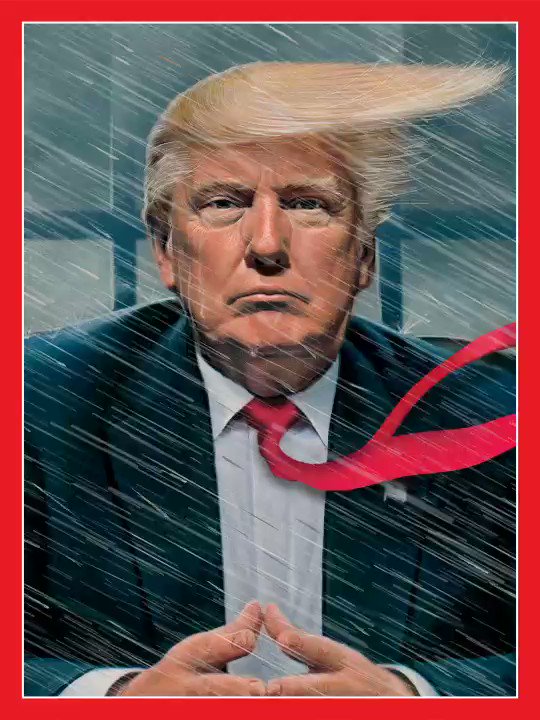
Despite his well-documented obsession with appearing on magazine covers, President Donald Trump may not be as keen on collecting the cover of the week's Time magazine.

Illustrated by Tim O'Brien for the accompanying story "Inside Donald Trump's White House Chaos," this week's cover reflects the tumultuous first month of Trump's presidency, which included a botched ban on travel from seven majority-Muslim countries, revelations about the Trump campaign's ties to Russia, and a failed Cabinet nominee and national security adviser.


Follow

TIME
✔@TIME


TIME’s new cover: Inside Donald Trump's White House chaos http://ti.me/2kNjcjU
9:09 PM - 16 Feb 2017

41,08141,081 Retweets
55,76555,765 likes


The president has long had a love-hate relationship with Time, keeping stacks of magazines with him on the cover on his desk in New York for years — a habit he continued at the White House.

"Look at that picture of me on Time," Trump told a reporter in his office last year. "It's a movement! Isn't that an amazing picture? It's been a lot of fun."

He has frequently commented on the magazine's leadership and staffing, and he railed against it in 2015 after it failed to make him its person of the year, an honor he received after his upset election win in 2016.


"I was on their cover four, five weeks ago," Trump told a crowd at an Arizona rally in 2015. "They should have picked me for the person of the year, but they didn't. No, they should have."

He continued: "I said I'm never going to get it because I'm not establishment. But every panel that I saw on television when Time was — because, you know, it's sort of cool, even though the magazine's going down the tubes. No, it's a cool thing. Most magazines are going down, in all fairness to them. It's great, isn't it? To watch these guys go down the tubes? Isn't it great? I love it."

SEE ALSO: We asked 11 media outlets how their coverage has changed since Trump's election — here's what they said

NOW WATCH: The president's close friend of 40 years explains Trump's sense of humor


h
More: Donald Trump TIME magazine

Leaders of 'The Resistance': 30 Americans taking the fight to Donald Trump


During the presidential campaign, we ranked “the most powerful Donald Trump haters.” Now the Republican candidate has become president, and so we must consider the growing Trump “resistance movement.” There’s actually not as much overlap between the two lists as you might expect. Opposing a president, after all, is a very different thing than opposing a candidate, with the former even including some Americans with non-partisan motives. Whether you’re pro-Trump or anti-Trump, these are the “resisters” you need to know...
Photos: AP


Alec Baldwin


No one has gotten under Trump’s skin quite like the famously liberal actor, who has been portraying the new president on the iconic comedy-sketch show “Saturday Night Live” since last fall. Trump has repeatedly attacked the “SNL” skits on Twitter, insisting they’re “totally biased, not funny and the Baldwin impersonation just can’t get any worse.” Baldwin quickly responded: “Release your tax returns and I’ll stop. Ha.”


Jerry Brown


Faced with the Trump administration potentially halting climate-change research, the California governor angrily declared, “If Trump turns off the satellites, California will launch its own damn satellite." The president, meanwhile, responded to the possibility that the liberal bastion will become a “sanctuary state”: "If we have to, we'll defund. We give tremendous amounts of money to California." (The Golden State, unlike many others, actually sends more money to the federal government than it receives back.)


Kate Brown


Oregon’s governor is calling on progressives to dedicates themselves to the anti-Trump cause. "It's going to require more than you're bargaining for," she told The New Yorker. "Activism will change your life." Critics in her home state, however, want her to concentrate not on the problem in the White House but on the problems in Oregon. The Oregonian editorial board has insisted Brown is in a “state of denial” about the state’s public-pension crisis.


Follow

Donald J. Trump
✔@realDonaldTrump


My daughter Ivanka has been treated so unfairly by @Nordstrom. She is a great person -- always pushing me to do the right thing! Terrible!
10:51 PM - 8 Feb 2017

27,57227,572 Retweets
143,666143,666 likes


Shannon Coulter


The marketing professional founded #GrabYourWallet, which encourages consumers to boycott companies that do business with the Trump family. “In a world where I often feel powerless over the forces of evil, I now use my wallet to NOT give money to those we know support really, really, really bad people,” she said. The campaign has had notable successes, with Nordstrom, Neiman Marcus and others dropping Ivanka Trump’s line. Now in Coulter’s sights: Amazon.


Bob Ferguson


Not long ago, Washington’s attorney general had a low public profile in his home state -- and none in the rest of the country. Now, as the man who brought the lawsuit that ultimately halted President’s Trump’s travel ban, he’s the new anti-Trump rock star. And he’s not done yet. He said Sunday he plans to uncover “what truly motivated” the executive order, including seeking evidence that it was crafted not for national-security reasons but because of the president’s personal bias against Muslims.


Charles Fried


The Harvard law professor and solicitor general for President Ronald Reagan believes Trump’s war on the federal judiciary sets a very dangerous precedent. “Judges can be criticized. That's fine,” he told NPR. “It is the way in which ... this man chooses to criticize them [that] is indecent, disrespectful and casts shame on the office of the president and, unfortunately, therefore, on all of us.” He argues that Reagan was the antithesis of Trump: “He was a humane person.”


Alicia Garza


The Black Lives Matter leader admits she was conflicted about January's Women’s March on Washington, concerned that it was a “white women’s march” that minimized the country’s class and racial problems. But she decided she had to embrace “something that isn’t perfect” because “no one is safe from the transition this country is undergoing. While many of us have faced hate, ignorance and greed in our daily lives, the period that we have entered is unlike anything that any of us has ever seen before.”


Lindsey Graham


The South Carolina senator, a Republican, has repeatedly shown he’s willing to take on the president. When Trump made unsubstantiated claims last month that millions of undocumented immigrants voted for Hillary Clinton, Graham said: "I would urge the president to knock this off. ... People are going to start doubting you as a person if you keep making accusations against our electoral system without justification."


Eric Holder


The California Legislature has hired Holder to fight Trump policies in court, reportedly at a cost of $25,000 a month in taxpayer money. “Having the former attorney general of the United States brings us a lot of firepower in order to prepare to safeguard the values of the people of California,” said state Sen. Kevin de Leon. Holder is also chairman of the new National Democratic Redistricting Committee, an attempt to cut into the GOP’s gerrymandering advantage.


Jay Inslee


Washington state’s governor declared that the court action against President Trump’s travel ban “demonstrates the importance of governors and states in the four-year battle to preserve the fundamental values of this country. This nation needs checks against a president who’s prone to rogue behavior, and governors will assume a more important place in the democratic system.”


Garrison Keillor


Through his radio show “A Prairie Home Companion,” the humorist became the soothing voice of small-town America. Now he has taken on a new identity: relentless Trump critic. “Everyone knows that the man is a fabulator, oblivious, trapped in his own terrible needs,” he wrote of the president. “Republican, Democrat, libertarian, socialist, white supremacist or sebaceous cyst -- everyone knows it.” He has called on the Republican Congress to remove him from office.


View image on Twitter


Follow

Shia LaBeouf
✔@thecampaignbook


http://WWW.HEWILLNOTDIVIDE.US
NOW LIVE

Museum of the Moving Image, New York
9:00 PM - 20 Jan 2017

18,91818,918 Retweets
36,79536,795 likes


Shia LaBeouf


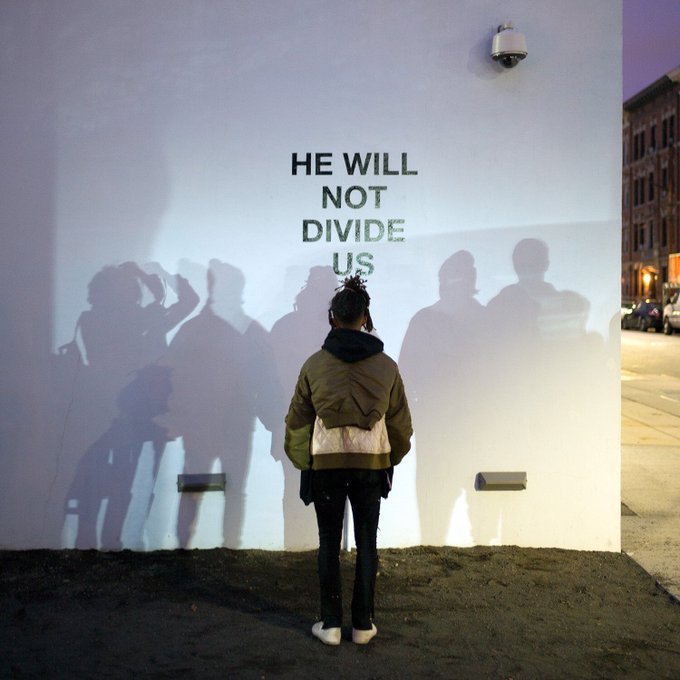
The former rising young actor has focused on odd performance-art pieces in recent years, the latest of which was “HEWILLNOTDIVIDE.US,” a “participatory internet streaming performance” outside New York’s Museum of the Moving Image. The museum aborted the exhibition after three weeks because it “had become a flashpoint for violence.” LaBeouf was disgusted with the museum’s decision, tweeting: “The museum has abandoned us.”


Bill Maher


Back in 2012, the acerbic comedian mocked Trump’s “birther” efforts against President Barack Obama by offering to give $5 million to charity if Trump offered up a copy of his birth certificate to prove he’s not a “spawn of his mother having sex with an orangutan.” Now he says he’ll give Mitt Romney $1 million (as if the 2012 GOP presidential nominee needs the money) and “become a Mormon ... if you will please take over the country.”


Tamika Mallory


The activist was a co-chair of January's March on Washington. She has helped launch a gun-violence-prevention program in New York City and heads up her own strategic planning company. “People understand,” she said recently, “that we need loud voices to push back on the issues that we see happening today -- the threat that people are feeling, the imminent threat that communities are up against.”


John McCain


The 2008 GOP presidential nominee did his best to avoid criticizing Trump during the election campaign. But since securing his sixth Senate term, McCain has let his contempt for the new president show. After the Vietnam War hero criticized the Yemen raid that was Trump’s first use of American military power, The Washington Post wrote: “We just got a taste of a more-unplugged McCain, who has been antagonizing Trump for weeks.”


Michael Moore


The Oscar-winning filmmaker and progressive activist famously called it: Last summer, when most seasoned political pundits dismissed the idea that the bombastic former reality-TV star could win the election, Moore declared that Trump would ride Rust Belt anger into power. Now that his prophecy has come to pass, the documentarian is leading a “100 Days of Resistance” effort to derail Trump’s and the GOP Congress’ agenda.


Keith Olbermann


The former ESPN and MSNBC talker has found his voice again, thanks to Trump. He calls his new internet show “The Resistance” and recently put out a video detailing the “50 craziest things Trump has done as president.” Said the 58-year-old: “More people are paying attention to my message at the moment than they would be if I were some other host on MSNBC or CNN.” The Washington Post recently asked: “Have liberals found their combative new leader in ... Keith Olbermann?”


John Oliver


It was the “Last Week Tonight” host who turned the Trump family’s ancestral name -- Drumpf -- into an expletive. He’s also perfected “investigative comedy,” in which he takes an episode-long deep dive into a particular political hot topic. But even though Rolling Stone calls him the ideal comedian for the Trump era, Oliver says he isn’t ready to devote himself to The Resistance. He said recently: “I hope we'll be able to protect the majority of the show from the president."


Nancy Pelosi


Some Democratic House members didn’t want Nancy Pelosi to remain as minority leader. After all, the Dems had suffered a stunning defeat and Pelosi, at 76, represented an old-school, kumbaya style of liberalism that the new wave of progressive activists rejected. But Pelosi held onto her position, and she’s embraced a combative stance. For example: Unlike her colleagues, she’s put aside euphemisms and called White House political strategist Steve Bannon “a white supremacist.”


Carmen Perez


The 40-year-old former probation officer founded a youth-leadership organization and co-founded The Girls Task Force. She is currently the executive director of the racial-justice organization The Gathering for Justice. Speaking of the impact of the Women’s March, she said: “There are also those who have never participated in any type of movement -- grandmothers who woke up on November 9 feeling so defeated. Their form of resistance is coming together in a very radical way.”


Rhea Powell


Donald Trump’s shock victory has led many women to consider running for office. One of them is this young Philadelphia doctor, who has participated in anti-Trump protests and enrolled in a training program for fledgling Democratic candidates. She decries the partisan-drawn legislative boundaries that favor Republicans in many states, admitting: “I am worried that because of the impact that gerrymandering has had on many of the districts that it may be hard to make big changes.”


Robert Reich


The UC Berkeley professor and former U.S. Labor secretary has been at the forefront of the resistance movement, putting out videos that detail President Trump’s lies, the meaning behind his attacks on the press and more. Last week Reich even suggested that the recent violent protest that shut down the planned Berkeley-campus talk by alt-right provocateur Milo Yiannopoulos was staged by Trump forces “to lay the groundwork for a Trump crackdown on universities and their federal funding.”


Cecile Richards


The president of Planned Parenthood played a key role in January’s Women’s March on Washington and sees it as a template for the ongoing resistance. She says feminists of every ideological stripe and gender need to stand together and keep insisting on being heard. “One of us can be put aside,” she said. “Two of us can be ignored. But together, we are a movement. And we are unstoppable.”


Bernie Sanders


The Vermont senator, who ran for president in the Democratic primaries last year, isn’t worried only about the president’s policies. He’s worried about his mental health. "I use the term 'delusional' with regard to Trump,” he told CNN last week. “He said there were 3 to 5 million 'illegals' who voted in the last election ... That is delusional. Nobody in the world believes that is the case. There is zero evidence to back it up. But he makes that statement. So I think the word 'delusional' is correct."


Linda Sarsour


The Women’s March co-organizer and longtime advocate for Muslim-Americans has earned a high profile -- and the condemnation of the political right. The conservative journal National Review wrote in February that she “seems to have no qualms about associating with outright extremism,” adding: “While the Left may have an extraordinary tolerance for extremism, a lasting republic doesn’t."


Ben Sasse


Senate Republicans are standing with Trump, backing even his most controversial cabinet nominees. But that doesn’t mean they’re all happy -- or necessarily will stick by his side for long. Nebraska’s junior senator, a long-time critic, recently took issue with Trump declaring a moral equivalency between the U.S. and Vladimir Putin’s Russian government. "Let's be clear," Sasse said. "Has the U.S. ever made any mistakes? Of course. Is the U.S. at all like Putin's regime? Not at all."


Adam Schiff


The Los Angeles-area congressman pulled no punches when Trump criticized the jurist who suspended his travel ban as a “so-called judge.” Tweeted Schiff: “This ‘so-called’ judge was nominated by a ‘so-called’ President & was confirmed by the ‘so-called’ Senate. Read the ‘so-called’ Constitution.” He has proudly declared that California is not part of Trump’s America: “We believe in dreamers, climate change and healthcare for all. We build futures, not walls. We are Californians.”


Teresa Shook


The night after the election, the Hawaii grandmother had an epiphany: women should march on Washington. She started a Facebook page for such an event and went to bed. "When I woke up, it had gone ballistic," she said in December. A movement was born. After the January Women’s March on Washington turned out millions of people across the world, she insisted: “This is just the beginning.”
Protesters at the March

Meryl Streep


When the acclaimed actress criticized Trump during her Golden Globe Awards speech in January, he responded by calling her “over-rated.” On Saturday, at a gala for the Human Rights Campaign, she hit him again. “If we live through this precarious moment, if his catastrophic instinct to retaliate doesn’t lead us to nuclear winter, we will have much to thank our current leader for,” she said. “He will have woken us up to how fragile freedom is.”


Andrew Sullivan


The conservative blogger has launched a “weekly diary” for New York magazine to write “about, among other things, the end of Western civilization, the collapse of the republic, and, yes, my beagles.” He makes clear that this new endeavor is all about responding to Trump and the president’s “denial of empirical reality,” which Sullivan says is “about enforcing his power rather than wriggling out of a political conundrum.”


More


Anti-Trump activists have promised ongoing marches and other disruptions. The next big nationwide protest is expected to be April 15, an event designed to pressure the president into releasing his tax returns, which would show his various possible conflicts of interest.

Jeffrey Lord insists Trump presser was ‘relaxed, funny, on point’ — then attacks CNN


esident Donald Trump’s Thursday press conference had many people talking. Addressing the latest White House scandal involving former national security advisor Gen. Michael Flynn, Trump said “Russia is fake news” noting later, “the leaks are absolutely real, the news is fake.”

In reality, Trump gave a weapons-grade crazy 77-minute press conference. However, CNN contributor and Trump supporter Jeffrey Lord had a different take on that “meltdown.” Speaking with CNN hosts Jake Tapper and Wolf Blitzer, Lord said, “I think we saw two different press conferences.”

“From my perspective, I thought he was relaxed, he was funny, he was on point. He took the whole issue of the media, and he had a very candid conversation,” Lord said. “This is the kind of conversation that I personally had with him a couple years ago in which he said some version of this same thing that he said today, except he was more specific.”

Lord described the president as “candid, very dedicated to the job, very in command.”

“What about some of the back and forth that he had with reporters? You used to work in the Reagan White House — is that really presidential four weeks into a new term?” Blitzer asked. “I think this is going to be his presidential style,” Lord replied.
Report Advertisement

Tapper later mentioned a reporter from NBC who called out President Trump for incessantly calling the media “fake news” while also “saying things that are not true,” noting the reporter was asking, “How do you have credibility to call us fake news?”

“I think it was a simple mistake,” replied Lord, calling the reporter’s question “nitpicky.” He then proceeded to launch an attack on the network. “I had somebody here locally say to me during the campaign, you know, they recognized me, and they came over and they said — and it was a comment about CNN, which I’ll be happy to make on air here, just so you know,” Lord started.

He continued, “They said if Donald Trump sneezed, CNN would spend four days talking about his damage to the environment. That’s the kind of perception, not just about CNN, but about the media at large, and that’s the kind of feeling that he addresses.”

Watch the full clip below.

Celebrities React: Donald Trump Press Conference Speech Bashing Media, Bragging About Administration

Celebrities are reacting to the speech Donald Trump gave during a press conference on Thursday, in which he criticized the state of America, bashed the media, and touted the work of his administration. See reaction tweets from Hollywood stars below.
Trump’s press conference at the White House was originally billed as a media briefing on his new labor secretary. But after naming Alexander Acosta as his new nominee, replacing the controversial Andrew Puzder, the president gave a wide-ranging speech. He touted his electoral college victory, insisted he’s “inherited a mess,” and bragged about his administration’s accomplishments.
“There’s never been a presidency that’s done so much in such a short period of time, and we haven’t started the big work,” Trump insisted. After his prepared remarks, the president took questions, the first of which was on former national security adviser Michael Flynn. Despite asking for his resignation, Trump insisted Flynn did “nothing wrong” with Russia, and called all the reports linking his campaign and administration to the U.S. enemy “fake news.”
As the Q&A continued, Trump went on various tangents, at one point saying, “I’m not a bad person.” He decried the supposed tone of “hatred,” and insisted he wasn’t “ranting and raving.” The president also name-checked Hillary Clinton several times. And while this all unfolded, a number of stars live-tweeted their reactions in real-time.
“Is….is anyone watching this?” Josh Groban tweeted with a frowning emoji. He went on, “I mean. Unhinged. This isn’t politics. This isn’t red and blue. This is reality and insanity. Both sides of the aisle, please protect us. I can’t laugh about him anymore. It just isn’t funny. I feel genuinely scared about his confusion and egomania. We are in a tailspin.”
Billy Eichner exclaimed, “This speech MY GOD.” He also quoted Trump as saying during the press conference, “‘I was given that information…I don’t know…I think I’ve seen it somewhere’ -The President of the United States.” After Trump slammed government leaks but then said he didn’t have a problem with WikiLeaks, Rainn Wilson posted, “Leaks = BAD!!! WikiLeaks = GOOD!!!”
Samantha Ronson said, “No matter how many times you say otherwise, you lost the popular vote. LOST. LOST. 3 million. #stoplying #notmypresident.” She also retweeted a freelance writer, who observed, “Trump called himself the least racist person then assumed a random black reporter could set up a meeting with the Congressional Black Caucus.” Referring to the crazed Sunset Boulevard character, Ike Barinholtz declared, “Trump’s delusion level is Norma Desmond.” Sharing a gif of Bill Murray shaking his head, Josh Gad quoted Trump saying, “The leaks are real but the news is fake.”
“Not watching Trump presser but if I were just going off my twitter feed, it would appear that Danny DeVito in Cuckoo’s nest is our President,” Gad also wrote. In response to when the President said, “I’m not ranting and raving, I’m just telling you, you’re dishonest people,” Eliza Dushku tweeted, “#facepalm.” John Fugelsang wrote, “If the Russia scandal gets any bigger Donald Trump promises a swift response of blaming Hillary & mocking CNN’s ratings.”
Sky Ferreira retweeted a New York critic, who posted, “‘I haven’t spoken to anyone in Russia in years… I spoke to Putin twice after the election’ I’m screaming.” Debra Messing also retweeted a former congressional candidate, who wrote, “THE. ROLL. OUT. WAS. PERFECT. He said that about the #MuslimBan with a straight face.” Kathy Griffin noted, “If ur looking for something to do, our ‘precedent’ is having a full meltdown on tv right now. #TrumpNewsConference.”
Sophia Bush shared this from an MSNBC reporter: “Trump refuses to directly answer question on whether anyone in campaign had contact with Russia, only says ‘nobody that I know of.'” Christina Applegate simply wrote, “Cray.” Alec Baldwin remarked, “This guy is so wired in front of the press. Like he’s gonna blow a rod. Imagine what he’s like behind closed doors…”
After someone else noted, “A Jewish reporter asked about rising anti-Semitism, and Trump called him a liar, told him to stop talking, and didn’t answer the question,” Chelsea Clinton wrote, “One would think he would have thought of an answer since yesterday. Here’s one: There’s no place for any bigotry, ever, in America.” She was referring to Wednesday’s press conference with Trump and Benjamin Netanyahu, during which Trump was asked about anti-semitism, but gave a non-answer.
“At all times, it feels like we’re just moments away from trump shouting, ‘WHY IS EVERYONE BEING SO MEAN TO ME,'” tweeted Tyler Oakley. Katie Couric asked her followers, “If you’re watching @realDonaldTrump press conference please tweet me your thoughts.” And J.K. Rowling admitted, “Up until an hour ago, the scariest thing I’d ever watched was Psycho. #TrumpPresser.
Minnie Driver shared an exchange in which Trump downplayed giving out misinformation, and wrote, “Ok, this is from the #45 press conference that JUST happened. Fake news? You know what isn’t fake? The fact that he lies.” Scott Foley expressed with disappointment, “This. Is. our. President. We chose him. Yes, we.” Yvette Nicole Brown tweeted, “Did he just ask #AprilRyan if the Congressional Black Caucus are friends of hers? Because we ALL know each other (& look alike) amirite?”
“What’s happening?” wrote Ben Stiller. Star Jones pointed out, “Trump says he had the largest EC victory since Reagan. LOL. Only if you don’t count 5 of the 7 last elections.” Meanwhile, Piers Morgan said, “Memo to my ‘outraged’ media friends: Trump has no interest in being your idea of ‘presidential’. He won by doing it his unique (!) way.”

Lorne Michaels Continues To Feed The SNL Anti-Trump Rhetoric Spew Machine


Has SNL Become too Political?

Every 4 years, during the election cycle, the political commentary grows louder. Despite already living in a 24 hour news cycle, with round-the-clocknews channels and the perpetually accessible internet, the political commentary seemingly permeates to all aspects of media: sports, entertainment, comedy, etc. As the collective interest in the political sphere crescendos during the election, the interest and coverage, typically return to the mean. Saturday Night Live (SNL), was not unique in its inclusion of politically relevant topics. SNL routinely comically recapped important events on the campaign trail.

While the two primary candidates for the election were Democratic Candidate Hillary Clinton and current president, Donald Trump, the jokes were disproportionately doled at the expense of Trump. SNL being an entertainment show, has one predominant focus, to continue to produce content that garners good ratings. Given the two personalities, irrespective of their political leanings, the more polarizing figure is Donald Trump, and Trump certainly does not quell that notion, or the attention. His personality has always been brash and outspoken, Trump does not shy away from headlines or sound bites, and at times may even embrace them. Clearly a strategy that won the favor of many, given that Trump, ultimately won the presidency.

But as we begin to enter March 2017, two months after Trump’s inauguration, SNL has not eased up on the Trump material. As the skits including Trump and his administration are a staple of the once-per-week show. President Trump is indeed any easy target, as evidenced by the nightly TV monologues on just about every late-night talk show, but at some point, SNL, and the creative team (including creator Lorne Michaels) have to wonder if the well will begin to dry, or if the net gain of repeatedly going to said well, is greater than alienating some of its viewers. The material is certainly not endearing to those who are fans of the President, but also, the material is frowned upon by those who simply want less of the political commentary. Comedy, a medium, that understandably has to reside in the realm of current events, is also a medium that people embrace as to escape from the real world. The constant inclusion while, popular and providing comedy to some maybe, providing resentment and fatigue to others. And, from a non-partisan comedy purist perspective, some viewers just want to see new original material.
SNL Bordering Between Parody and Fabrication

Trump is no stranger to sketches on the SNL, as his likeness has been parodied since 1988, by over 5 different actors: Phil Hartman, Darrell Hammond, Jason Dudeikis, Taran Killam and most recently Alec Baldwin. Since 2015, Trump’s character has appeared in more than 22 sketches, and since he’s taken office, Trump and his staff have made almost weekly appearances as characters on the show. On February 4th, 2017, Melissa McCarthy who was guest host, made her hilarious debut as White House Press Secretary Sean Spicer. McCarthy’s role as Spicer featured abrasive exchanges with the media and an overall crude demeanor, essentially mocking the White House Press Secretary’s competency. McCarthy reprised her role as Spicer again the following week on February 18th, 2017, in a similar appearance, which featured Spicer ingesting mouthfuls of gum in an unflattering manner, while speaking and subsequently attacking a news reporter with his podium.

The SNL parodies have extended to other members of the President’s cabinet, including Trump’s senior adviser Kellyanne Conway, played by Kate McKinnon. The sketch stepped outside of simply caricaturing the senior adviser and included a Fatal Attraction – like parody, in which Conway plays a psychotic stalker similar to that of the movie, where she unceremoniously shows up at the house of CNN anchor Jake Tapper, threatening him with a knife in order to be allowed on CNN again. The skit was alluding to a recent controversy that involved the senior adviser reportedly being declined to appear on CNN for “credibility” concerns, after her “Bowling Green Massacre” slip-up.

It is hard for a prominent sketch comedy show to ignore “trending” issues, but in the Conway skit, SNL demonstrated far-reaching creative freedom by including a real member of the president’s cabinet and portraying them in a completely fictitious scenario, one that implies Conway may be violent or afflicted with certain mental health issues, as to involve her likeness, in stalking and threatening a real-life CNN anchor. As a show that has been on since 1975, SNL is more than the average sketch-comedy TV show, and despite creator Lorne Michaels, suggesting that the show cannot change viewers’ minds when it comes to politics, evidence would prove the contrary. As the widely popular Tina Fey impersonation of Sarah Palin, mistakenly attributed the now infamous, “I could see Russia from my house” line, a quote that many people actually believe was uttered by the 2008 Vice-Presidential nominee, but was in fact only ever spoken as Tina Fey, on a 2008 episode of SNL, in which she imitated Palin. While SNL does not necessarily have an obligation to be factually accurate, it creates a dangerous precedent in which the parodies and spoofs are not based on reality but merely conjecture. With that possibility, it proposes a potentially dangerous question in that, will the next skit, regarding the President and/or his Cabinet members include a completely fabricated premise that is in no way based in real-life and introduce perceptions that are not justified. Having already insinuated that a Presidential adviser can commit stalking and potentially homicide, what is to say that the next skit will involve something more heinous, such as drug-abuse, violence against women or pedophilia.
Is SNL Showing a Partisan Bias?

During the election cycle, both candidates were parodied, and whether these appearances were beneficial or detrimental to the election result is up for debate. Many political commentators believe that Trump’s appearance as a host actually helped his popularity, and that Mckinnon’s portrayal of Clinton was ultimately unfavorable. According to Lorne Michaels, SNL has always delved into politics, citing classic example of Chevy Chase as Gerald Ford in 1976, Dan Aykroyd as Richard Nixon in 1978, Dana Carvey as George H.W. Bush in 1996 and Jay Pharoah as Barack Obama in 2012, despite the numerous appearances of presidential parodies on SNL, this current chapter involving President Trump is shaping up to be the most vitriolic. During the entire presidency of Barack Obama, SNL did not antagonize the president and certainly not his cabinet members in the same manner that they have attacked Trump. Although, it is hard to deny that Trump may be feeding into the baiting by demonstrably reacting to the antics of SNL through Twitter. In which the President tweeted that SNL was not funny and really bad television. Trump also reportedly took offense, to the February 14th skit, in which assistant and Chief Strategist Steve Bannon (played by a grim reaper) was influencing Trump to make rash diplomatic decisions with other countries. In Trump’s relatively short time in office, SNL has made a poignant effort to include and attack the President, and while it is in the spirit of comedy, it does have shades of partisanship. In a November interview with Esquire magazine, SNL comedian Michael Che, agreed that the criticism of Trump on the comedy show was “too one-sided”, he continued to explain that comedy should take both sides and make fun of both parties. As it stands now, SNL has clearly taken a political leaning to the left, a perception that cannot be good for its brand long term.
Political Inclusion Resulting in Record-High Ratings

The election and post-election cycle brought ratings numbers SNL had not seen in 20 years. According to a marketplace article. SNL experienced a 22 percent jump from the previous season, resulting in 10.6 million viewers. Throughout the years SNL ratings have been cyclical and they are currently relishing in an upswing, aided by the election cycle and their political coverage, but as with the rest of the entertainment and news media, anything related to the current president and his administration is still an easy, cheap laugh. Still less than a quarter into Trump’s first year of presidency, viewers are already feeling “Trumped” out. SNL has been able to capitalize with increased viewership thus far, but it remains to be seen whether the show will be able to maintain this ratings surge if they continue to utilize the same tactics of hammering the current administration and coming off as a left-leaning satirical machine, in the same vein as The Daily Show on Comedy Central.
SNL’s Effect on Public Perception, Worse than Fake News?

The backbone of SNL is satire. The more popular a topic is, the more logical it is for the show to hone in on that topic. No matter how funny a skit maybe, it’s appeal to the masses relies on how many people are exposed to that topic. The presidential election, provided a quantitative bump in news-related media across the board. The New York Times reportedly added 41,000 paid subscriptions across its platforms since the presidential election, an amount that represented its largest subscription increase since 2011, according to CNN. SNL pounced on the opportunity to ride the coattails of the election buzz and it has paid dividends in record-high ratings but given its recent string of skits that are so evidently biased against the current president and his administration, SNL and its creative team have to be aware of the message that people are receiving. Whether it is their intention or not, consistently attacking Donald Trump and his administration is shaping the perception that SNL is an anti-Trump machine. News channels, MSNBC and FOX News are categorized as left and right – leaning media outlets, respectively, but that perception is based on their content and both conglomerates do not shy away from those perceptions. Whether news should be partisan is an argument in itself, but it is a reality of American media. When a comedy program, with as much clout as SNL, decides to dabble into the political spectrum it teeters on the edge of a precarious slippery-slope. In an age where “Fake News” is rampant, be it by numerous click-bait websites infiltrating hundreds of thousands of people’s social media feeds, or by actual “credible” news organizations themselves, delivering such agenda driven information that the actual facts are obfuscated in such a way, the message is inaccurate, SNL is clearly on the spectrum of media that is shaping the opinions of it’s viewers.

Unlike the news outlets, SNL can hide behind the veil of comedy, and its inherent plausible deniability that it is a not a news network; but the material on SNL is obviously anti-Trump, and prohibitively favoring the left. Both candidates were embroiled in scandals during the campaign trail; however, SNL focused primarily on Donald Trump’s controversies (Trump’s temperament on Twitter, the Billy Bush incident, allegations of misogyny and racist remarks), while being seemingly copacetic with the controversies surrounding Hillary Clinton, (email scandal, Benghazi incident, controversy surrounding the Clinton Foundation) based on the amount of times these topics were involved in SNL’s skits. It also makes it all the more obvious when Alec Baldwin, who plays Trump, actively endorses Clinton and has publicly feuded with Donald Trump on social media and publicly voiced his bitterness with the result of the election. Now Baldwin is tasked with lampooning the individual, who is the current president of the United States, on a weekly basis, while also having a personal vendetta against him. SNL can claim to be apolitical, but the reality is that the actor satirizing the president is not, and while that may not make the skits less funny, it presents an illusion that SNL is complicit in antagonizing Donald Trump. An idea that SNL and NBC has not actively tried to dissuade, and an idea that is beginning to become more and more apparent. In regards, to the most Conway Skit on SNL, a New York Times Reviewer, was quoted as saying the show suffers from a sense of exhaustion, and questioned how much longer the show can keep up with the anti-Trump material, a question that will continual to grow louder and louder as the SNL Trump bashing continues.

Is it wrong to laugh at Donald Trump? Steven Johnson

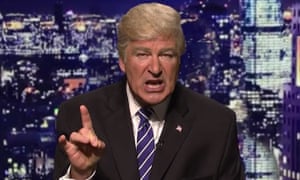
‘Trump clearly finds Alec Baldwin’s take on him to be infuriating.’ Photograph: CNN / SNL


View more sharing options

Shares
3,180


Friday 10 February 2017 10.52 GMTLast modified on Friday 10 February 2017 15.36 GMT


Whatever else you might want to say about the first weeks of the Trump era, one fact is undeniable: we are living in the golden age of hand-lettered signs. History will judge how effective the Women’s March and the airport protests of last week turn out to be, but as protest movements go, I suspect they were unrivalled in terms of genuinely clever one-liners.

The signs were everywhere – on Instagram and Twitter and email – cardboard memes designed both for the crowd they were immersed in, and the great teeming after-party of social media. Some were gleefully profane: “This pussy grabs back!”; “now you’ve pissed off grandma”. Some were meta, like the many variations of the “Not normally a sign guy, but geez” placard that first appeared in the weeks after the election. Some found comedic defiance in rewriting the canon of resistance, like the sign that appeared at JFK the night after Trump signed the immigration executive order: “First they came for the Muslims, and I said NOT THIS TIME FASCISTS!”


I suspect one of these days a Stephen Colbert or Samantha Bee will run for national office

The signs were only part of a larger story. American liberty, tolerance and the separation of powers may be under fire, but so far, against all odds, laughter is thriving in the Age of Trump. Fittingly for a presidential campaign that, by many accounts, first emerged out of Barack Obama’s roasting of Trump at the White House correspondents’ dinner, comedy has woven a bright and defining thread through the events of the past six months. Make no mistake, these are dark times for the Republic. But they have also been uncommonly funny.

I find the persistence of laughter to be heartening, as incongruous as it might seem. Incongruity is one of the fundamental forces in the universe of comedy: take two things that don’t usually belong together; throw them into the same sentence; hilarity ensues. Dark comedy in particular thrives in juxtaposing the solemn, the mortal, with the petty and the prurient. So it makes sense that we should find ourselves reaching for punchlines when we want to throw punches. When things are bleak, we lean on humor to fight back, to build bonds, to whittle away at the pedestals of the powerful.


Donald Trump's first 100 days as president – daily updates

Read more

Humor is no substitute for engaged journalism: we still need White House reporters eliciting leaks from within Trump’s inner circle, and Jake Tapper calling out Kellyanne Conway’s lies on CNN. But the jokes have played a defining role in framing the Trump administration, establishing the defining tropes. The master-narrative that seems to be emerging that Trump and his emissaries have an Orwellian relationship to the truth came from the #alternativefacts memes circulating through social media: fake transcripts of Sean Spicer saying preposterous things followed by “Period”; mock remembrances of Conway’s fictitious Bowling Green Massacre.
Advertisement
Report this ad


Laughter turns out to be central to the resistance for another reason: the unique cocktail of authoritarian bellicosity and emotional neediness that is Donald Trump. Presidents and presidential candidates have been skewered on Saturday Night Live since Chevy Chase’s bumbling Gerald Ford impression in season one, more than 40 years ago. (Asked a challenging economics question during a debate parody, Chase’s Ford replied, “I’m sorry, but I was told there would be no math on the exam.”) But most politicians easily shrugged off those impersonations, or happily played along with the gag.

Trump, on the other hand, clearly finds Alec Baldwin’s take on him to be infuriating; a number of sources confirm that Melissa McCarthy’s savage impression of Sean Spicer has seriously damaged the press secretary in the eyes of his boss. The autocrat can be feared or despised and still maintain his power. But he cannot be ridiculous.

The prominence of satire in the age of Trump is surely also a product of the sheer number of satirists now at work. When George W Bush took office in 2001, social media as we know it did not exist, and only two television shows were serving up political humor on a regular basis: Jon Stewart’s Daily Show, which had just gone on the air a few years earlier, and Bill Maher’s Politically Incorrect. Stewart is – tragically – sitting this one out, but he has been replaced by late-night hosts whose material is fixated on mocking Trump at every opportunity: Stephen Colbert, Samantha Bee, Trevor Noah, John Oliver, Seth Meyers and Maher himself.

That deep bench of political comedy may well end up having a more direct impact on politics. In the weeks after Trump’s election, several commentators suggested that the Democrats should seriously consider running their own celebrity for president. (Traditionally, this is a Republican tactic, from Ronald Reagan to Schwarzenegger’s California governorship, to Trump himself.) But even more potent than a mere celebrity would be a celebrity comedian. I suspect one of these days a Stephen Colbert or Samantha Bee will run for national office and prove to be incredibly effective candidates. They will have the celebrity allure of Trump or Reagan, but they will actually be able to think on their feet in the way that a great comedian can, particularly one trained in improv. They will be devastating on the stump and in a debate, and they’ll get votes of that crucial subset of the American electorate that votes purely along celebrity recognition lines.
Is it possible that the joke is on us? Gallows humor doesn’t always save you from the gallows, after all. Writing for the New Yorker, Emily Nussbaum observed the way Trump himself ran his campaign events like a Vegas insult comic. “His rallies boiled with rage and laughter, which were hard to tell apart,” she wrote. “You didn’t have to think that Trump himself was funny to see this effect: I found him repulsive, and yet I could hear those comedy rhythms everywhere, from the Rodney Dangerfield ‘I don’t get no respect’ routine to the gleeful insult-comic slams of Don Rickles … to Andrew Dice Clay, whose lighten-up-it’s-a-joke, it’s-not-him-it’s-a-persona brand of misogyny dominated the late nineteen-eighties … where [Trump] still seemed to live.”
Advertisement
Report this ad


Nussbaum is certainly correct in her portrait of Trump’s “braggadocious” humor (a favorite non-word of the president’s), and she’s right to find something menacing in that posture. In all the sci-fi imaginings of our dystopian futures, no one anticipated a world where Triumph the Insult Comic Dog wins the presidency and promptly sets up an authoritarian regime.

But I suspect that comedy will turn out to be on the side of the angels. Partly this is the nature of jokes themselves. The list of authoritarian comics is a short one. Humor generally comes from the underdogs and outsiders; satire works when you are mocking the powerful; when you yourself have the power, you’re just a bully. (Case in point: Trump’s notorious imitation of disabled New York Times reporter Serge Kovaleski.)

So far, the feedback loop between public mockery and White House reaction is already so tight that Trump opponents have, in recent days, been actively soliciting satire that portrays Trump as the hapless puppet of Steven Bannon, in a deliberate effort to turn Trump against his white nationalist adviser. We are learning, in these early days, that jokes and memes have a role to play not unlike the protest gathering themselves: a way of building solidarity, focusing the general public on the abuses of the administration, applying pressure where the White House is most vulnerable. Not to mention that other intangible benefit of humor in dark times: keeping each other sane.

Years ago, the late media scholar Neil Postman wrote a prophetic book about the escapism of the television age called Amusing Ourselves To Death. A bleak future America where a reality TV show personality is elected president would have seemed entirely plausible to Postman. But I suspect he would have been surprised by the nascent power of humor as a form of resistance, the strange new channel that opens up when you combine the scrawled satire of the cardboard signs and the digital 140 characters of Twitter. Facing a regime so vulnerable to satire, and living in age where a well-turned joke can reach millions, the American left may well find itself reversing Postman’s formula, and amusing itself back to life.